
Home of Hepatology7 rue Daubin1203 GenevaSwitzerland+41 22 807 03 60easloffice@easloffice.eu© 2025 EASL. All rights reserved.Website by Soto.Privacy Policy | Cookie Policy | Terms & Conditions | Cyber Security Explore offerUnlock the full potential of being part of the EASLcommunity. As a member, you’ll gain access toexclusive resources, reduced event fees, top-tierjournals, and professional development opportunitiesdesigned to support your career in hepatologyBecome a memberNurses & Allied Health ProfessionalsLink titleYoung InvestigatorsLink titleBasic ScienceLink titleTitle here Lorem ipsum At the heart of EASL is a diverse and dynamic international community of professionals dedicated to advancing hepatology.Discover how you can get involved and make an impact.Whether you're a member, a Young Investigator, a nurse or allied health professional, or focused on basic science, there's a place for you here. Explore the different pathways to connect, grow and contribute, from membership benefits to tailored programmes and scientific networksLorem ipsum dolor sit ipsum CommunitySign In / Sign UpResourcesWhat We DoAbout Us Partnerships

News

DECISION – Project publishes fundamental study on immune mechanisms predicting outcomes in patients with ADC

The DECISION consortium has just published a fundamental study in the Journal of Hepatology on immune mechanisms predicting outcomes in patients with acutely decompensated cirrhosis (ADC).

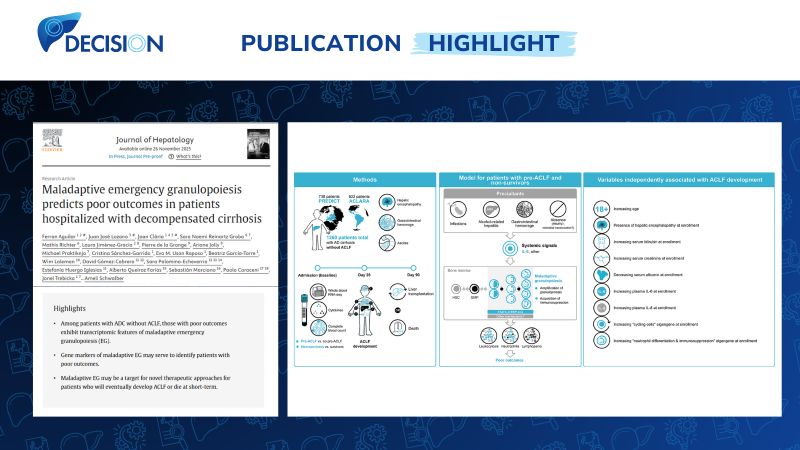
By analysing whole-blood RNA-sequencing (RNA-seq) data from over 1,200+ patients, researchers identified maladaptive emergency granulopoiesis (EG) as a key factor in patients at high risk of developing ACLF within 28 days.

  • Patients with poor outcomes exhibit transcriptomic features of maladaptive EG, including neutrophil activation and immunosuppressive signatures
  • Specific gene markers may help identify individuals at high risk for ACLF and short-term mortality
  • Targeting maladaptive EG may present a promising avenue for future therapies to prevent disease progression

The results strongly suggest that neutrophil-granulopoietic perturbations play a pathogenic role in the development of poor outcomes.

Read the full study here

Share
Scroll to Top

Search EASL