
Schools
About
EASL Schools help train the next generation of hepatologists and scientists. Through individual work, collaborative teamwork and discussions with faculty, students gain invaluable insight into new experimental techniques and clinical approaches.
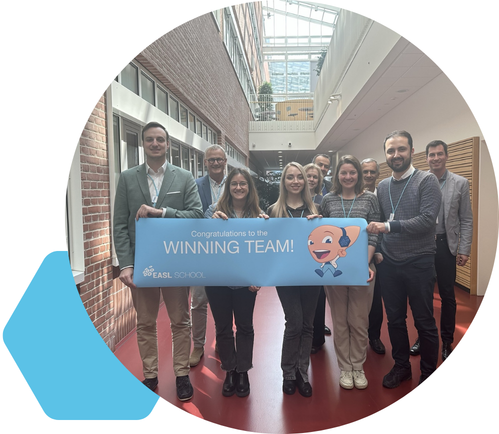
Upcoming Schools
Structure

Learner-centred format
The School welcomes up to 25 students and follows a flipped-classroom approach, focusing on active participation, problem-solving and independent learning.

Pre-course preparation
Complete the online course(s) and review educational materials available on EASL Campus during the month before the School. Pre-assessments must be completed before arrival.

Collaborative onsite learning
Work in small groups under the guidance of experienced tutors, with a strong emphasis on teamwork, discussion and cooperation.

Assessment and feedback
Complete post-assessments and surveys on EASL Campus after the onsite programme to evaluate learning outcomes and provide feedback.
CME accreditation
EASL applies for accreditation from the European Accreditation Council for Continuing Medical Education (EACCME) for all its educational activities.
Details of the number of CME’s accredited per event are available on the event web pages.
The EACCME is an institution of the European Union of Medical Specialists (UEMS) and EACCME credits are recognised by the American Medical Association towards the Physician’s Recognition Award (PRA).

I am an organiser
- Only EASL members may apply to host an EASL School. If you are not a member yet, you can become an EASL member now.
- EASL Schools must be hosted in dedicated European centres of excellence and be able to accommodate plenary sessions and breakout groups.
- EASL Schools must be led by experts of the hosting institution (Maximum 2 external experts are allowed).
- EASL Schools programme must not exceed 2 days.
- EASL strongly recommends maintaining a minimum gender balance ratio of 70% to 30% among the faculty participating in the EASL School programme.
The proposals will be reviewed by the EASL Educational Committee. EASL will allocate a dedicated budget to the successful applications. EASL office will provide the successful applicants with the related information and guidelines.
The programme must be based on the following structure:
Before the EASL School:
- Pre-assessments of the students through EASL Campus (online courses, live webinars, quizzes etc.).
- Group assignment.
Day One:
- Clinical cases study: Student groups are assigned complex clinical cases with tutors to guide them.
Day Two:
- Clinical cases presentations and selection of the winning group.
- State-of-the-art lecture by a renowned expert.
- Students’ evaluation of the school programme and format (Mandatory).
After the EASL School:
- Post-assessment tests and accreditation of the students through EASL Campus.
The programme must be based on the following structure:
Before the EASL School:.
- Pre-assessments of the students through EASL Campus (online courses, live webinars, quizzes etc.).
- Group assignment.
Day One:
- Experimental hands-on sessions.
Day Two:
- Experimental hands-on sessions.
- State-of-the-art lecture by a renowned expert.
- Students’ evaluation of the school programme and format (Mandatory).

I am a student
At the time of the EASL Clinical School, applicants must:
- Be ≤35 years old or within two years after completing internal medicine or gastroenterology-hepatology training.
- With 1.5 years allowance per child for parental leave in line with EU standards.
- Hold a PhD and/or MD registered higher medical degree.
- Be active EASL members.
Full, associate professors and/or senior lecturers will not be eligible.
At the time of the EASL Bootcamp: bridging the gap between science & medicine in hepatology, applicants must:
- Be late-stage clinical or scientific trainees or early-career professionals (typically within 0–6 years of completing their medical degree for clinicians or postgraduate degree for basic scientists).
- Be active EASL members.
Clinicians applying for the programme must hold an MD (or equivalent) and be in specialist training (e.g., hepatology, gastroenterology) or within up to 3 years post-specialisation.
Basic and translational scientists must be PhD students or postdoctoral researchers.
To promote global inclusivity, we may consider up to 10% of selected applicants from WHO-defined low-income countries, with more flexible eligibility criteria.
In addition:
- Applicants can only apply to one EASL School per year.
- Approximately 25 places are available for each school. Please make sure your EASL membership is active before submitting your application. Become an EASL member.
- Applicants should provide the following information:
- Full name & contact details
- Nationality & date of birth
- Participation in previous EASL Schools of Hepatology
- List of publications / abstracts
- Training, positions, year of completion
- Referee name & contact details
- CV (PDF format)
- Letter of motivation (PDF format)*
- Letter of recommendation (PDF format)*
- Copy of ID with birth date or proof of training
* The recommendation and motivation letters should explicitly state the reasons for the applicant’s participation, including how the programme will benefit the applicant’s professional development and contribute to the advancement of their laboratory or institution.
- For the EASL Bootcamp: bridging the gap between science & medicine in hepatology, applicants must also provide 3-5 arguments in their motivation letter on how the school will advance their specific ambition and needs in developing translational research in hepatology.
- Economy class roundtrip tickets. Travel allowance up to EUR 400. EASL will cover transportation to the host city by plane, train, and/or bus. However, local transfers within the city – such as those between the airport/train/bus station and the hotel, or between the hotel and the school venue – are not included.
- Two nights of accommodation.
- Visas are not covered by EASL.
- Infections in advanced chronic liver diseases, 4-5 June 2027, Zagreb (Croatia)
- Challenges in the treatment of hepatocellular carcinoma, 25-26 June 2027, Madrid (Spain)
- EASL Bootcamp: bridging the gap between science & medicine in hepatology, 16-18 September 2027 Rotterdam (the Netherlands)
- Portal Hypertension, 23-24 September 2027, Vienna (Austria)