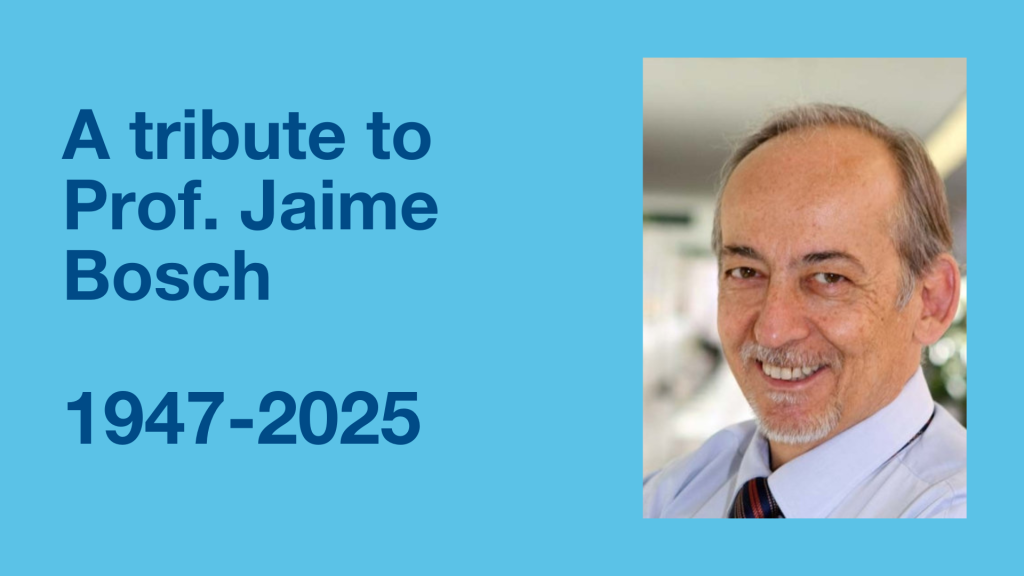
EASL joins the global hepatology community in mourning the passing of Professor Jaime Bosch, an exceptional clinician-scientist, educator and leader whose career has shaped the field of hepatology for over five decades.
Born in Girona, Catalonia, on 10 August 1947, Professor Bosch graduated top of his class from the University of Barcelona Medical School in 1970 and obtained his PhD in 1973. His early focus on hepatorenal syndrome laid the foundation for a career dedicated to improving the understanding and treatment of portal hypertension and liver disease. Following his clinical training at the Hospital Clínic of the University of Barcelona, he joined its Liver Unit in 1979, a centre that would become one of the world’s foremost institutions in hepatology.
Between 1980 and 1982, he trained under Professor Roberto Groszmann at Yale University, a collaboration that not only deepened his research into hepatic haemodynamics but also sparked a lifelong scientific partnership and friendship. Upon returning to Barcelona, Professor Bosch developed one of the world’s most influential research laboratories on portal hypertension, integrating advances in vascular biology and mentoring a generation of hepatologists.
A gifted researcher and prolific academic, Professor Bosch authored more than 400 peer-reviewed articles, led and contributed to numerous randomised clinical trials, and maintained international collaborations with leading liver units, including Yale, Faulkner Hospital and the Royal Free Hospital in London. His contributions significantly advanced the management of variceal bleeding, non-invasive techniques for measuring portal pressure, and the use of statins in liver disease. His work has directly improved care for thousands of patients around the world.
Beyond his research, Professor Bosch was a passionate educator, mentoring hundreds of international fellows and holding academic leadership roles including full Professorship at the University of Barcelona and Acting Chief of the Liver Unit. His influence also extended to national health research policy in Spain, where he served as Scientific Coordinator of National Research in Gastroenterology and Hepatology and advisor to multiple governmental bodies.
A dedicated member of EASL, Professor Bosch served on the Scientific Committee from 1980 to 1983 and contributed to the Journal of Hepatology as Associate Editor from 2004. In recognition of his outstanding career and ongoing contributions to the field, he was awarded the EASL Recognition Award in 2006.
Professor Bosch’s scientific excellence was matched by his humility, generosity and unwavering commitment to collaboration. He was a cherished mentor, colleague and friend to many in our community. EASL extends its heartfelt condolences to Professor Bosch’s family, friends and colleagues. We honour his life and remarkable contributions to hepatology, which will continue to resonate for generations to come.