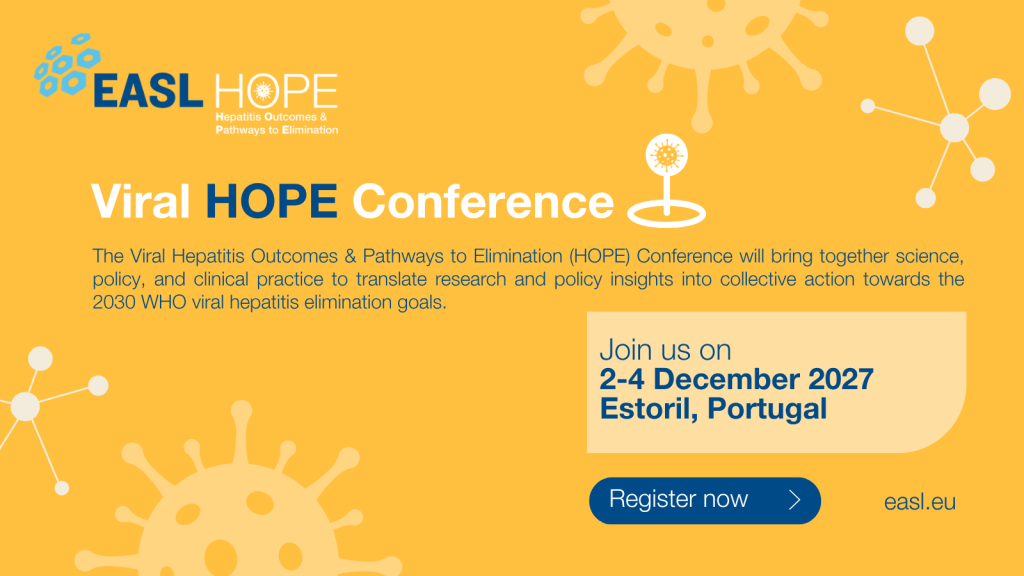
Viral HOPE Conference

Viral HOPE Conference
The Viral HOPE Conference 2027 will serve as the capstone event of EASL’s multi channel Viral Hepatitis Outcomes & Pathways to Elimination (HOPE) Programme. Building on insights generated through the Viral HOPE Research Grants and the Viral HOPE Policy Roundtables, the conference will consolidate new evidence, compare regional approaches, and mobilise the hepatitis community towards measurable progress on the 2030 WHO elimination goals.
The conference will convene international experts, clinicians, researchers, policymakers, and patient representatives, strengthening cross border collaboration and aligning scientific advances with policy priorities and real world implementation. Through this integrated approach, EASL will reinforce its leadership in driving hepatitis elimination across Europe and beyond.
Needs Assessment
Despite continued progress in prevention and treatment, the viral hepatitis landscape remains characterised by fragmented evidence, inconsistent clinical pathways, and uneven adoption of best practices across European health systems.
Key challenges include persistent gaps in screening and linkage to care, variable access to biomarkers for hepatitis B, limited real world outcomes data for hepatitis Delta, and disparities in national elimination strategies. Earlier workstreams within the Viral HOPE programme have highlighted these gaps and generated valuable scientific and policy insights.
The Viral HOPE Conference responds by translating research outputs into clinical and operational practice, showcasing comparative data across countries, and providing structured educational updates across priority disease areas. It also creates space for direct dialogue between scientific leaders, public health actors, policymakers, and patient representatives.
The Viral HOPE Conference is designed to support four core objectives.
Consolidate evidence generated through the Viral HOPE Research Grants and Policy Roundtables into a coherent scientific and educational framework
Strengthen clinical excellence by sharing best practices, guideline implementation strategies, and real world data
Bridge science and policy by aligning clinical innovation with public health priorities and elimination strategies
Foster collaboration across research networks, clinical centres, policy bodies, and civil society to accelerate progress towards elimination
- Latest evidence from the Viral HOPE Research Grants, including multicountry data on screening, diagnosis, linkage to care, and treatment pathways
Comparative progress towards the 2030 WHO elimination goals across the WHO Europe region, highlighting inequities and system level barriers
Implementation challenges and opportunities related to EASL Clinical Practice Guidelines, including biomarker access and standardisation
Advances in therapeutic strategies for HBV, HCV, and HDV, with emphasis on emerging data, real world outcomes, and unmet clinical needs
Integrated approaches linking science, policy, and public health to strengthen elimination strategies and micro elimination initiatives
Gaps in data collection and registry development, particularly for HDV and underserved or high risk populations
Priorities for future research, cross border cooperation, and EU level coordination to improve equitable access to care
- The conference will feature a multidisciplinary faculty, including.
National and regional elimination programme leads
Public health and data experts
Policymakers and health system stakeholders
Patient advocates and civil society representatives
This diversity of perspectives will ensure that scientific advances are examined alongside policy feasibility and real world impact.