
Clinical Practice Guidelines
EASL Liver Disease Management Guidance
EASL’s Clinical Practice Guidelines assist physicians, healthcare providers, patients and other interested parties in the clinical decision-making process. The EASL Guidelines present a range of state-of-the-art approaches for the diagnosis and treatment of liver diseases.

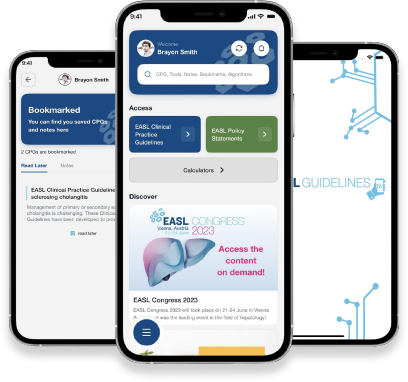
Download the EASL Guidelines App
- Consult EASL CPGs anytime, anywhere.
- Enhance your clinical decision-making with calculators and score.
- Expand your knowledge with continuously updated resources and tools.
- Viral Hepatitis
Hepatitis C virus (HCV) infection is a major cause of chronic liver disease. As a result, worldwide there are approximately 71 million chronically infected individuals. Clinical care for patients with HCV-related liver disease is advancing considerably. Most importantly thanks to an enhanced understanding of the pathophysiology of the disease. And
- Viral Hepatitis
The updated EASL Clinical Practice Guidelines on the management of hepatitis B virus (HBV) infection provide comprehensive, evidence-based recommendations for its management. Spanning ten thematic sections, the guidelines address diagnostics, treatment goals, treatment indications, therapeutic options, hepatocellular carcinoma surveillance, management of special populations, HBV reactivation prophylaxis, post-transplant care, HBV prevention
- Immune-mediated & Cholestatic Diseases
Autoimmune hepatitis (AIH) is a chronic liver disease of unknown aetiology which may affect any patient irrespective of age, sex, and ethnicity. At baseline, the clinical spectrum of the disease varies largely from asymptomatic cases to acute liver failure with massive hepatocyte necrosis. The aim of these EASL guidelines is
- Liver Tumours
Recent years have witnessed significant advances in the imaging, molecular profiling, and systemic treatment of cholangiocarcinoma (CCA). Despite this progress, the early detection, precise classification, and effective management of CCA remain challenging. Owing to recent developments and the significant differences in CCA subtypes, EASL commissioned a panel of experts to
- Cirrhosis & Complications
Extrahepatic surgery in patients with cirrhosis of the liver represents a growing clinical challenge due to the increasing prevalence of chronic liver disease and improved long-term survival of these patients. The presence of cirrhosis significantly increases the risk of perioperative morbidity and mortality following abdominal surgery. Advances in preoperative risk
- Cirrhosis & Complications
Transjugular intrahepatic portosystemic shunt (TIPS) placement is a well-established procedure for managing complications of portal hypertension. In recent years, the field of TIPS has seen rapid advances, particularly in technical approaches, prognostic modelling, and an expanding range of indications. The aim of these EASL guidelines is to comprehensively address all
- General Hepatology
Wilson’s disease is an autosomal recessive disorder of copper metabolism which affects the liver, brain and other organs. Diagnosis is based on: clinical features; biochemical tests, including plasma ceruloplasmin concentration, 24-h urinary copper excretion, copper content in the liver; and molecular analysis. Leipzig score and additionally relative exchangeable copper determination
- Liver Tumours
Liver cancer is the third leading cause of cancer-related deaths worldwide, with hepatocellular carcinoma (HCC) accounting for approximately 90% of primary liver cancers. Advances in diagnostic and therapeutic tools, along with improved understanding of their application, are transforming patient treatment. Integrating these innovations into clinical practice presents challenges and necessitates
- General Hepatology, Liver Transplantation & Surgery
Liver transplantation (LT) is an established life-saving procedure. The field of LT has changed in the past 10 years from several perspectives, with the expansion of indications, transplantation of patients with acute-on-chronic liver failure, evolution of transplant oncology, the use of donations after cardiac death, new surgical techniques, and prioritisation
- Immune-mediated & Cholestatic Diseases
Genetic cholestatic liver diseases are caused by (often rare) mutations in a multitude of different genes. While these diseases differ in pathobiology, clinical presentation and prognosis, they do have several commonalities due to their cholestatic nature. These Clinical Practice Guidelines (CPGs) offer a general approach to genetic testing and management